 |
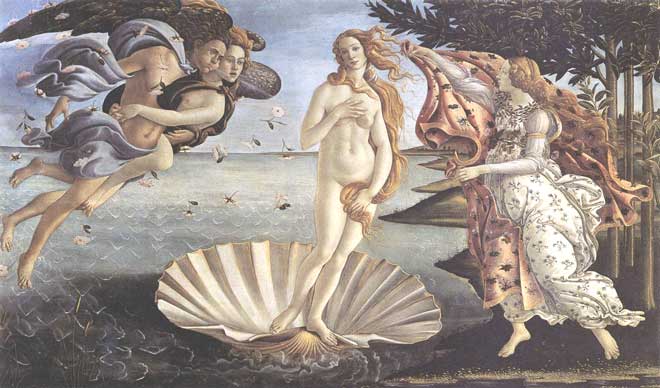
| The Birth of Venus - by Sandro Botticelli C. 1486 |
It would seem that many people base their opinion on the origin of Aphrodite on what they see or hear in day to day terms. For example on inscriptions of tablets, paintings on Greek vases and sculptures etc. Previously before I began my studies in Greek religion, I had always thought Aphrodite to be the daughter of Zeus - purely because Zeus had been portrayed as the greatest of the gods in films such as 'Clash of the Titans' and the literature such as the Cyclic poems. However since reading the hymns of the gods and the Theogony, my view on the birth of Aphrodite is more mixed. Also the famous painting by Sandro Botticelli: The Birth of Venus, C.1486 which depicts Venus (Aphrodite) being born from a clam in the sea - a similar reference to the Theogony, conflict my views further.
Sale (1961:514) has made this interesting point: 'Let us assume that Hesiod had heard that Aphrodite was Uranus' daughter, not an unreasonable assumption; but he certainly heard from Homer that Aphrodite was the daughter of Zeus. What induced him to choose the non-Homeric story, especially if he was the author of [Theogony sections 201-06] and therefore borrowed much from Homer? He had little interest in the epithet 'Urania' and had no desire to account for Aphrodite's role as sea-goddess'. I agree with Sale, I would say that considering Hesiod drew much of his inspiration for the Theogony from Homer, his reason for altering Aphrodite's origin could simply be to distinguish himself as a different poet from Homer, or a more famous poet perhaps.
Aphrodite's nature is shared amongst the different mediums of Greek literature. Cyrino (1993:220) states: 'the Hymn to Aphrodite contains many elements of scene structure and erotic language which are parallel to those shaping the seduction scenes of the Homeric epic poems. We may easily compare Aphrodites's erotic encounter with Anchises in the Hymn to the following epic scenes: Hera's seduction of Zeus in Iliad 14; the forced meeting between Paris and Helen, choreographed by Aphrodite in Iliad 3; and the meetings of Penelope and the suitors and of Penelope and Odysseus in the final books of the Odyssey.' What can we draw from this? Well to put it simply, Homer saw Aphrodite as a vehicle for love and lust, and her presence in both the Iliad and the Homeric Hymns shape future love involvements between particular characters - even if Aphrodite is not directly present in the scene.
Whilst Hesiod considers Aphrodite to be a very powerful being, her role in the Homeric epics frequently includes scenes of comedy, or comic relief. Rosenzwieg (2004:8) states: 'Homer balances Aphrodite's power with an element of comedy. The memorable episode from book 5 from which Aphrodite attempts to rescue her beloved son Aeneas from the battlefield is comic indeed. Aided by Athena, Diomedes thrusts his spear into the flesh of Aphrodite's delicate hand, and the goddess runs home to her mother'...'Through Zeus' mocking tone, he implies that Aphrodite's realms of power are of lesser import and imparts to them a sort of second class status'. This is another indication by Homer that he sees Aphrodite as inferior to not only Zeus, but also Athena and even a mortal Diomedes! It is possible however that Homer was simply enforcing the heroic and brave nature of Diomedes, rather than rebuking the weak and delicate Aphrodite.
On the whole though, Aphrodite's various backgrounds continue to be one of the most interesting topics for debate among Greek religion. Does it really matter that there are conflicting views about her background? I find it all adds to the fascination behind studying Greek religion!
Further Reading:
W. Sale (1961) Aphrodite in the Theogony. Transactions and Proceedings of the American Philological Association, Vol. 92, pp 508-521
M. S Cyrino (2004) 'Shame, Danger and Desire:' Aphrodite's power in the fifth Homeric Hymn. Rocky mountain review of language and literature, Vol 47, No 4, pp 219-230
R. Rosenzweig (2004) Worshipping Aphrodite: Art and cults in classical Athens. University of Michigan press
