Thursday, 8 December 2011

'Who mourns for Adonais?'

Michael Forrest as 'Apollo' (courtesy of www.startrek.com)

As this could well be my final posting in my Greek religion blog, I feel I should utilise my 'original idea' format and talk about one of my favourite topics revolving around Greek religion. Now before I start, I shall warn readers that this posting might not appeal to everyone, and it is entirely fictitious - but then again, Greek mythology has its fictitious aspects! The title of this posting refers to an early episode of the TV series of Star Trek, which stuck in my mind thanks to its portrayal of the Greek god Apollo.


The reason why I have included this as a blog is that in one of the scenes, Kirk (the captain) comes up with the theory that the Greek gods were not mythological beings, and fragments of the ancient Greeks' imagination, but they were in fact creatures with abnormal powers from a different part of the universe who took on the form of humans and resided in ancient Greece. To the ancient Greeks they would have been seen as gods! When these 'beings' saw that humanity did not need the assistance of 'gods' they went off to different parts of the galaxy.

So in short, while this could be interpreted as a rather silly or irrelevant point, I feel it is fascinating that we take the aspects of Greek religion for granted. We, the scholars, the historians and the students have to base our knowledge of the Greek gods on sources from the time such as Homer and Hesiod. Ancient greek lives from people such as Apollodorus, however who's to say these people really knew why they worshipped the Greek gods? What if they were in fact real beings. Every myth has it's basis and founding, the Trojan war is widely believed to have occured, thanks to the recent excavations in modern day Turkey. Wood (1998:4) states: 'there was a justifiable reluctance among scholars to admit the idea that the epics have a real connection with historical events of the thirteenth century BC. Indeed the feeling was fairly widespread that the Trojan War was simply a myth and had no relation to history whatsoever. The new discoveries in archaeology, diplomatic records and linguistics are continuing to fill in a real historical background to the Trojan War.' While this doesn't prove the real existence of the Greek 'gods', it does leave us with a thought that we should not be so naive when we think of the gods as simple a 'myth' (perhaps!)

This topic is linked somewhat to the religious belief of gods in general. Wisdom (1944:185) has stated 'The existence of God is not an experimental issue in the way it was. An atheist or agnostic might say to a theist "you still think there are spirits in the trees, nymphs in the streams, a God of the world". He might say this because he noticed the theist of the time in drought pray for rain and make a sacrifice and in the morning look for rain. But disagreement about whether there are gods is now less of this experimental or betting sort than it used to be.' I  think that Wisdom has a fair point here, perhaps the existence of the Greek gods were real, but only in the minds of Greek people when in times of need or distress. Admittedly, it looks likely that the writers of Star Trek had a vivid imagination; compelling, but vivid nonetheless!

Fictional the show may be, however anyone who views this episode cannot shake off that seed of doubt that is in their minds regarding the origins of the gods. McLaren (1999:39) states: 'In the encounter with Apollo, we have cut the last cord to a pre-scientific understanding of the cosmos with its myths of the gods. Nevertheless, something in the back of our minds is unsettled and unsatisfied. At the corners of consciousness we sense that the cosmos is colder than it was before. Some nameless dread, some angst, crowds unwelcomed into our psyche. We are not reassured; we are disquieted.' This is a compelling point, which only adds to the fascination of the existence of the gods. I am not saying I will start a conspiracy theory about the Greek gods, I am simply saying is it really that silly to think that they were real? We can trust the ancient sources, there is no real reason why we need to dispute them! But for those of us who like to go against the norm, there is that little crumb of comfort of Star Trek to call upon!

Further Reading:

M. Wood (1998) In search of the Trojan War. University of California press
J. Wisdom (1944) Gods. Proceedings of the Aristotellian society. New series, Vol 45 pp 185-206
J. E Porter & D. L McLaren (1999) Star Trek and sacred ground: explorations of Star Trek, religion and American culture. SUNY press

Dionysos

Dionysos has long been a favoured deity of mine. This is because he is arguably the god that stands apart from the rest of the olympians and lesser gods. He is portrayed as a rule-breaker, the god of transgression and ultimately the opposite of Zeus. Whenever I think about Dionysos, it is difficult to think of anything other than possession, sense of ecstasy, and a loss of self!

 In this posting I intend to explore the question of 'Why is he a god?' This links indirectly to my first and second posts where i explored the question of 'what makes a god?' Despite the fact that he is not noted as one of the 12 Olympians, he is worshiped by his many followers who dedicated widespread festivals on a frequent basis, that they perceived him as a god. Larson (2007:127) states: 'the major Dionysiac festivals can be assigned to the Ionian and Athenian Greeks or to the Dorians and the Aiolic speakers of Thessaly and Boiotia. This division also corresponds to two early centers of Dionysiac activity, the Aegean islands and Boiotian Thebes. The islands, particularly Chios and Naxos, were leading producers of wine and proponents of Dionysos as the god of viticulture whose sacred marriage with Ariadne ensured prosperity.' What we can see here is that Dionysos' followers had an abundance of festivals ranging from a large geographical area across the Aegean sea, from Thessaly to Chios. Evidently a hugely popular deity to worship.

So why is he a god? My biggest criticism of this fact is the issue of his birth, in that he is born from the immortal Zeus, and the mortal Semele. However in similar fashion to many other Greek births, his mother is disputed amongst sources; ancient Cretans believing he was born from Persephone. Rengel (2007:86) has stated 'his mother is variously thought to be Semele, Demeter, Persephone, or Io, Dione or Lethe. The most common myth identifies his mother as Semele' Whilst this is an important point it alters the term of whether he is a god or not. In other words Dionyos would surely be considered a demi-god if he was born from Semele, similar to the likes of Perseus and Achilles - epic heroes who performed heroic exploits. Therein lies the issue - what has Dionysos done that was heroic except for possesing his followers and getting them uncontrollably drunk! So perhaps it would be more reasonable to assume that the Dionysos was born from Persephone.

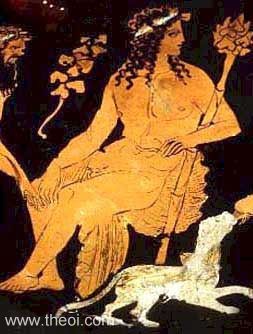
Another issue is the fact that he is perceived as more human than god thanks to his eccentric nature. As previously mentioned, he stands out more than the other gods due to his transgression. Perhaps it could be argued that his expressive nature is down to his human characteristics (being a son of a mortal woman) and that being the son of the supreme Zeus, he embodies the power to possess followers (godlike) and limit their free-will, while at the same time using typically dark human traits such as fornication and excessive drinking. Benson (2008:201) states: 'Dionysus would seem to be an immanent rather than a transcendent god. The complication with Greek gods is that some of them are simultaneously immanent and transcendent - very strangely so. They have human characteristics but also divine characteristics.' Is he therefore considered to be more human or god? Again this is down to interpretation. I personally feel he is one of the more human-like gods, not just in appearance (see bottom) but also in nature. Perhaps Zeus created Dionysus to be the embodiment of both human and god - to provide common ground between the two races.

I have used these points as they are the most interesting issue to do with Dionysos, whilst many believe it is his followers (the maenads) or his nature. Therefore I have tried to incorporate some of those aspects into this posting! For further reading please see the extended bibliography below.

Further Reading:

J. Larson (2007) Ancient Greek Cults, a guide. Routledge
K. N Daly & M Rengel (2009) Greek & Roman mythology A to Z. Infobase publishing
B. E Benson (2008) Pious Nietzsche: Decadence and Dionysian faith. Indiana university press
F. Musgrove (1974) Ecstasy and Holiness: counter culture and open society. Taylor & Francis
L. B Zaidman & P. S Pantel (1992) Religion in the ancient Greek city. Cambridge university press


(left) Dionysos as a young man with his thyrsos (pine-shaped staff) from an Athenian red-figured hydria, c. 5th century BC http://www.theoi.com/Olympios/Dionysos.html
(right) Dionysus depicted as an older man with his customary drinking vase (courtesy of http://carlanthonyonlinedotcom.files.wordpress.com/2011/03/dionysus.jpg)

Thursday, 1 December 2011

Blog Workshop analysis

Having spent half a lecture listening to my fellow students dissect and pick apart various blogs, including some interesting constructive criticism on my own, I feel it is necessary to explain briefly the key areas which I think makes a good blog.

Now firstly, everybody is entitled to their own opinion, and there are plenty of different criteria which is used in creating blogs - this is simply my opinion, which hopefully most people will agree with!
My ideal blog has to agree with a subject matter. In this case, my subject matter is Greek religion and aspects about it which I personally find fascinating. Unlike some of my fellow students who are doing posts on a single subject, for example 'the role of Athena within the pantheon', I prefer to talk about a range of topics which enable me to explore a wider variety of criteria, as well as keeping my audience interested with my topics and further to prevent repeating myself!

Referencing or linking is essential, that much is certain. We cannot come up with interesting topics for discussion without enlisting the help of other works as focal points. Reynolds (2007:118) came up with this interesting point: 'Bloggers tend to link to original sources wherever possible. The result is that you can follow the link and make up your mind for yourself. A blog that doesn't have links is less interesting. The link isn't a guarantee of accuracy, of course the source you're using can always be wrong - but it does let the readers evaluate the source themselves.' In my case, my 'links' take the form of references, and I try to add as many references as I feel are necessary for a particular point. For sure, many people will try to quote and quote until they're blue in the face, but if their quotes aren't relevant or too heavy to read then what is the point? Quality not quantity in my opinion!

One criticism that arose during the blog session was that my ideas lacked originality. Now while I can understand this point, I do not feel that a lack of originality infringes on the quality of the posting. For example we can take one idea that we studied in class and go further with it in our posting - something which I hoped to achieve with my Aphrodite posting. Nevertheless my next postings will hopefully involve more original ideas which are also interesting!

Right, rant over, I will now take on board the criticism and hopefully incorporate some of the tips into my future postings!

Further Reading:
G. Reynolds (2007) An army of Davids: how markets and technology empower ordinary people to beat big media, big government and other Goliaths. Thomas Nelson Inc.
S. Gardner (2005) Buzz marketing with blogs for dummies. John Wiley & Sons

Thursday, 10 November 2011

Aphrodite and her different backgrounds

The goddess Aphrodite, and her position within the hierarchy of the Greek gods has been hotly debated for centuries. The ancient poets Homer and Hesiod differ in their views of Aphrodite's birth. The Homeric epic poems state that she was born from Zeus and Dione and therefore subservient to Zeus from a genealogical perspective, whereas Hesiod's Theogony states that she was born from the genitals of Uranus, one of an older generation of gods, and so is above Zeus in the hierarchy. Having said that, Hesiod does not make that explicit - the idea of whether Hesiod perceived Uranus to be above Zeus in the hierarchy is down to interpretation. Two sources with two different views, but does that necessarily mean that we, the scholars and readers have to choose to believe one or the other? If so which source sounds more feasible?

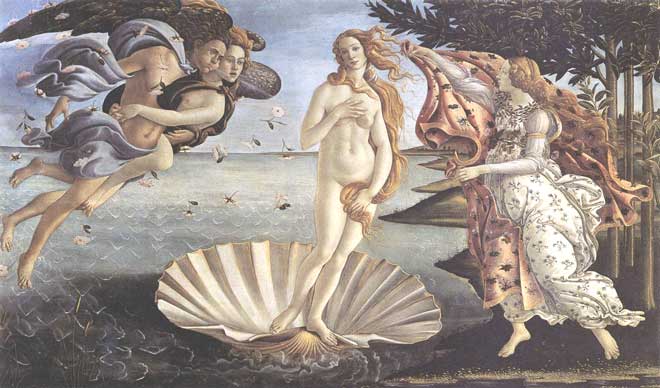
The Birth of Venus - by Sandro Botticelli C. 1486


It would seem that many people base their opinion on the origin of Aphrodite on what they see or hear in day to day terms. For example on inscriptions of tablets, paintings on Greek vases and sculptures etc. Previously before I began my studies in Greek religion, I had always thought Aphrodite to be the daughter of Zeus - purely because Zeus had been portrayed as the greatest of the gods in films such as 'Clash of the Titans' and the literature such as the Cyclic poems. However since reading the hymns of the gods and the Theogony, my view on the birth of Aphrodite is more mixed. Also the famous painting by Sandro Botticelli: The Birth of Venus, C.1486 which depicts Venus (Aphrodite) being born from a clam in the sea - a similar reference to the Theogony, conflict my views further.

Sale (1961:514) has made this interesting point: 'Let us assume that Hesiod had heard that Aphrodite was Uranus' daughter, not an unreasonable assumption; but he certainly heard from Homer that Aphrodite was the daughter of Zeus. What induced him to choose the non-Homeric story, especially if he was the author of [Theogony sections 201-06] and therefore borrowed much from Homer? He had little interest in the epithet 'Urania' and had no desire to account for Aphrodite's role as sea-goddess'. I agree with Sale, I would say that considering Hesiod drew much of his inspiration for the Theogony from Homer, his reason for altering Aphrodite's origin could simply be to distinguish himself as a different poet from Homer, or a more famous poet perhaps.

Aphrodite's nature is shared amongst the different mediums of Greek literature. Cyrino (1993:220) states: 'the Hymn to Aphrodite contains many elements of scene structure and erotic language which are parallel to those shaping the seduction scenes of the Homeric epic poems. We may easily compare Aphrodites's erotic encounter with Anchises in the Hymn to the following epic scenes: Hera's seduction of Zeus in Iliad 14; the forced meeting between Paris and Helen, choreographed by Aphrodite in Iliad 3; and the meetings of Penelope and the suitors and of Penelope and Odysseus in the final books of the Odyssey.' What can we draw from this? Well to put it simply, Homer saw Aphrodite as a vehicle for love and lust, and her presence in both the Iliad and the Homeric Hymns shape future love involvements between particular characters - even if Aphrodite is not directly present in the scene.

Whilst Hesiod considers Aphrodite to be a very powerful being, her role in the Homeric epics frequently includes scenes of comedy, or comic relief. Rosenzwieg (2004:8) states: 'Homer balances Aphrodite's power with an element of comedy. The memorable episode from book 5 from which Aphrodite attempts to rescue her beloved son Aeneas from the battlefield is comic indeed. Aided by Athena, Diomedes thrusts his spear into the flesh of Aphrodite's delicate hand, and the goddess runs home to her mother'...'Through Zeus' mocking tone,  he implies that Aphrodite's realms of power are of lesser import and imparts to them a sort of second class status'. This is another indication by Homer that he sees Aphrodite as inferior to not only Zeus, but also Athena and even a mortal Diomedes! It is possible however that Homer was simply enforcing the heroic and brave nature of Diomedes, rather than rebuking the weak and delicate Aphrodite.

On the whole though, Aphrodite's various backgrounds continue to be one of the most interesting topics for debate among Greek religion. Does it really matter that there are conflicting views about her background? I find it all adds to the fascination behind studying Greek religion!

Further Reading:
W. Sale (1961) Aphrodite in the Theogony. Transactions and Proceedings of the American Philological Association, Vol. 92, pp 508-521
M. S Cyrino (2004) 'Shame, Danger and Desire:' Aphrodite's power in the fifth Homeric Hymn. Rocky mountain review of language and literature, Vol 47, No 4, pp 219-230
R. Rosenzweig (2004) Worshipping Aphrodite: Art and cults in classical Athens. University of Michigan press

Monday, 17 October 2011

Polytheism & worshipping 'Demons'

In this week's lecture, we looked at 'Polytheism' and the impact it had on the ancient Greeks. Polytheism simply means the worship of numerous divine beings. As Dicks (1959:296) stated - according the Thales: 'Water is the primary substance of the universe, and that the world rests on water, and that everything is full of Gods', it is fair to say that the ancient Greeks had a wide range of divine beings to worship - and this wasn't limited to the 12 Olympians. The ancient Greeks also worshipped mythological beings such as 'Daimones' (demons) whom apparently did not have the same negative connotations that a modern day demon has. Rather a 'Daimon' roughly translates as a 'lesser god' or 'spirit guide'.

The scholar Robert Newton (1995:44) found some sources from Hesiod which state that 'demons were good, Zeus saw that the world was full of mischief, sorrow, and disease and in his infinite wisdom sent down invisible guardians to watch over us'. This is a stark contrast to what I believe a modern day demon represents - a bringer of evil and sorrow, fallen angels who rebelled against God and were banished into darkness. It would be interesting to speculate as to what point in time the view on demons shifted from good to evil. In my opinion it would have had to have happened when Christianity had a major impact on the west during the time of Jesus Christ, circa 30 AD. According to Holding (2008:281): 'back in the day, pagans and Christians alike believed that the world contained countless spirits floating in the air around them. For Pagans these spirits were 'Daemons', some evil and some good. Daemons were intermediaries between humans on earth and gods in heaven, responsible for many things such as blessing and curses, messages from the gods, and good and bad weather and so on. For Christians, these spirits were generally considered to be evil; i.e. 'demons'. Demons loved to spread malicious gossip and untruths.' It would seem then that the term 'demons' had different connotations depending on the religion, but evidently it was at this time when the term 'demons' had is negative meaning.

St. Anthony plagued by demons - Martin Schongauer c.1480

Another category of divine being is that of heroes and heroines - a topic which I discusses briefly in my previous posting. The worship of characters who performed heroic exploits. The largest and possibly the most notable was that of Herakles and his series of labours. Herakles was hugely popular to the people of ancient Greece, the evidence lies in his portrayal on vase paintings, sculptures, coins and gemstones, not to mention references in poetry and other literature, e.g. Euripides' The madness of Herakles. According to the poet Pindar (complete world of Greek myth), Herakles was seen as a 'straightforward model for athletic prowess'. In other words, Herakles was worshipped by many citizens of ancient Greece as they saw him as a greater man and a symbol of male perfection.

It is well known that each Greek city had its own pantheon with a figurehead deity, such as Athena for Athens or Hera for Argos. However in my opinion citizens were divided in who to worship as a deity. Perhaps not every Athenian agreed that Athena was the true god to worship! Therein lies the problem with a Polytheistic approach - conflicts are going to occur with divided opinion, with neither interpretation being wholly correct. The Homeric Hymns are a good example, as they celebrate each god individually such as hymn 23 To Zeus (see bottom) This would cause problems down the line for a Polytheistic approach, as each hymn would draw favour towards one god or goddess, and not them as a whole.

In the early 20th century, critics of the Paris School took a very controversial stance by stating that Polytheism was overly systematic, believing that it was natural to look at each god individually. They took the story of Hippolytos into consideration, where Hippolytos valued Artemis over Athena, dishonouring her despite claiming to hate women. Aphrodite then punishes Hippolytos for his crimes.

Overall it is down to individual interpretation as to how the ancient Greeks worshipped their deities, in my opinion the controversial view on Polytheism makes me feel that it is a more debatable term than I thought before!

XXIII. To Zeus


Zeus I shall sing: of the gods he is best, he is also the greatest.
Wide in his vision. He governs and brings everything to fulfillment,
Whispering words unto Themis, who sits inclining toward him.
Favor us, scion of Cronus, all-seeing, most honored, and greatest!

Further reading:
R. Newton (1995) Demons, The North American review, vol 280, no 6 pp 44-48
D. R Dicks (1959) Thales, The Classical Quarterly, new series, Vol 9, no 2 pp 294-309
J. P Holding (2008) Shattering the Christ myth. Xulon Press
R. Buxton (2004) Complete world of Greek mythology. Thames & Hudson
D. Hine (2005) Works of Hesiod & the Homeric Hymns. University of Chicago press - page reference 186

Introduction, blog breakdown and what is a god?

Hello there!
This is a blog which I have created in order to keep up to date my studies in Ancient Greek Religion - a popular module at my university!

In my blog I will explore various deities with the help of ancient sources such as the Homeric Hymns and Theogony, and also give my personal opinions on the different aspects of Greek religion as and when I study them in my lectures each week. Not to mention the relevant scholarship which I will call upon to digest and analyse as many aspects of Greek religion that I find fascinating!

The reason why I chose Ancient Greek Religion was because I've always held a fascination with the various Greek gods which stems from my love of the epic poems - Iliad and Odyssey, and also how they were perceived to the people of ancient Greece. I had always wondered whether the citizens of Greece revered the gods to the extent that the characters from the epic poems did. - Ultimately this will lead to my final posting where I explore the origins of the Gods and state how real or mythological they were!
Furthermore I hold a firm interest in mythological heroes such as Theseus, Jason and Meleager, and was fascinated to find out that they were worshiped in a similar pedigree to their immortal gods Zeus, Athena and so on.

This made me think: 'What is a god? Do they need to be immortal and live in the heavens or beneath the sea?' The term 'god' might not be as tangible as many people believe. In my opinion, a god is simply a being, mortal or immortal that is worshiped and revered by the common man to such a degree which makes that common man aspire to be greater as a result. In any case, religion played a monumental role in the lives of the ancient Greeks.


Further reading:
D. Hine - Works of Hesiod and the Homeric Hymns, (chicago 2005)
R. Buxton - Complete world of Greek mythology, (thames & hudson 2004)