In this posting I intend to explore the question of 'Why is he a god?' This links indirectly to my first and second posts where i explored the question of 'what makes a god?' Despite the fact that he is not noted as one of the 12 Olympians, he is worshiped by his many followers who dedicated widespread festivals on a frequent basis, that they perceived him as a god. Larson (2007:127) states: 'the major Dionysiac festivals can be assigned to the Ionian and Athenian Greeks or to the Dorians and the Aiolic speakers of Thessaly and Boiotia. This division also corresponds to two early centers of Dionysiac activity, the Aegean islands and Boiotian Thebes. The islands, particularly Chios and Naxos, were leading producers of wine and proponents of Dionysos as the god of viticulture whose sacred marriage with Ariadne ensured prosperity.' What we can see here is that Dionysos' followers had an abundance of festivals ranging from a large geographical area across the Aegean sea, from Thessaly to Chios. Evidently a hugely popular deity to worship.
So why is he a god? My biggest criticism of this fact is the issue of his birth, in that he is born from the immortal Zeus, and the mortal Semele. However in similar fashion to many other Greek births, his mother is disputed amongst sources; ancient Cretans believing he was born from Persephone. Rengel (2007:86) has stated 'his mother is variously thought to be Semele, Demeter, Persephone, or Io, Dione or Lethe. The most common myth identifies his mother as Semele' Whilst this is an important point it alters the term of whether he is a god or not. In other words Dionyos would surely be considered a demi-god if he was born from Semele, similar to the likes of Perseus and Achilles - epic heroes who performed heroic exploits. Therein lies the issue - what has Dionysos done that was heroic except for possesing his followers and getting them uncontrollably drunk! So perhaps it would be more reasonable to assume that the Dionysos was born from Persephone.
Another issue is the fact that he is perceived as more human than god thanks to his eccentric nature. As previously mentioned, he stands out more than the other gods due to his transgression. Perhaps it could be argued that his expressive nature is down to his human characteristics (being a son of a mortal woman) and that being the son of the supreme Zeus, he embodies the power to possess followers (godlike) and limit their free-will, while at the same time using typically dark human traits such as fornication and excessive drinking. Benson (2008:201) states: 'Dionysus would seem to be an immanent rather than a transcendent god. The complication with Greek gods is that some of them are simultaneously immanent and transcendent - very strangely so. They have human characteristics but also divine characteristics.' Is he therefore considered to be more human or god? Again this is down to interpretation. I personally feel he is one of the more human-like gods, not just in appearance (see bottom) but also in nature. Perhaps Zeus created Dionysus to be the embodiment of both human and god - to provide common ground between the two races.
I have used these points as they are the most interesting issue to do with Dionysos, whilst many believe it is his followers (the maenads) or his nature. Therefore I have tried to incorporate some of those aspects into this posting! For further reading please see the extended bibliography below.
Further Reading:
J. Larson (2007) Ancient Greek Cults, a guide. Routledge
K. N Daly & M Rengel (2009) Greek & Roman mythology A to Z. Infobase publishing
B. E Benson (2008) Pious Nietzsche: Decadence and Dionysian faith. Indiana university press
F. Musgrove (1974) Ecstasy and Holiness: counter culture and open society. Taylor & Francis
L. B Zaidman & P. S Pantel (1992) Religion in the ancient Greek city. Cambridge university press
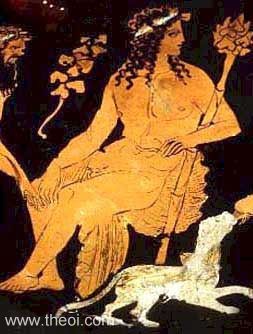  |
| (left) Dionysos as a young man with his thyrsos (pine-shaped staff) from an Athenian red-figured hydria, c. 5th century BC http://www.theoi.com/Olympios/Dionysos.html (right) Dionysus depicted as an older man with his customary drinking vase (courtesy of http://carlanthonyonlinedotcom.files.wordpress.com/2011/03/dionysus.jpg) |

No comments:
Post a Comment